Improving Nitrogen Use Efficiency in Dual-Purpose Maize Production through Optimized Nutrient Scheduling
DOI:
https://doi.org/10.38211/joarps.2025.06.322Keywords:
Nitrogen scheduling, yield components, forage quality, nutrient recovery, split fertilization strategyAbstract
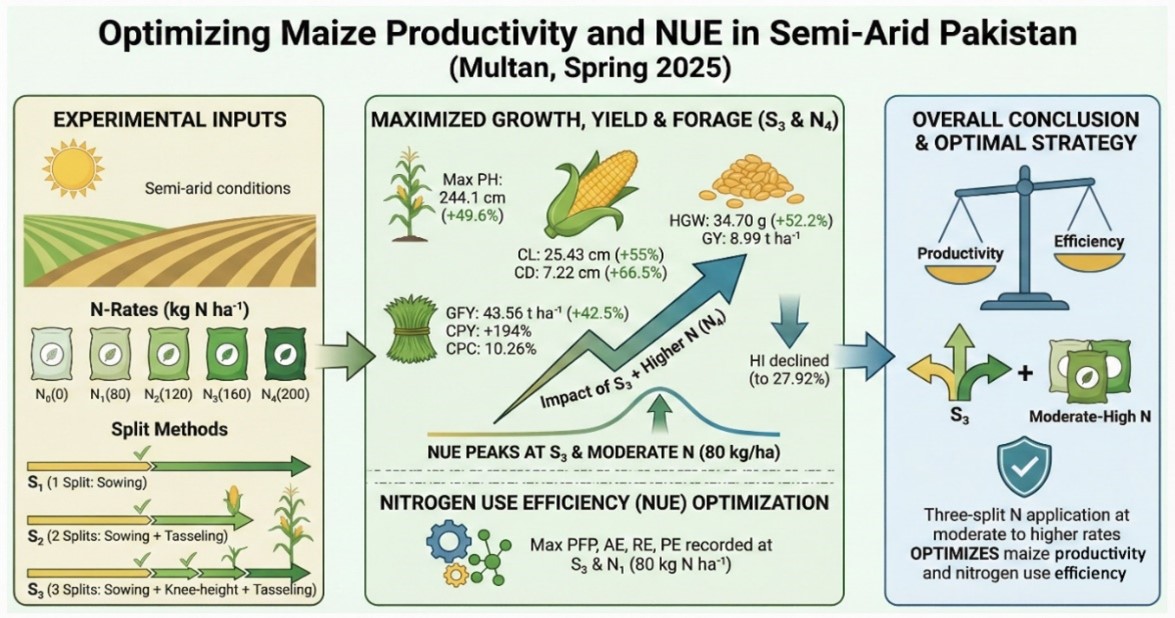
Timely and effective rate of nitrogen (N) and application is essential in enhancing the maize productivity and nitrogen use efficiency (NUE) in semi-arid areas of Pakistan. To determine the impacts of five N-rates, N0-N4 (0, 80, 120, 160, and 200 kg N ha-1) and three split applications S1 (whole sowing), S2 (two splits - 1/2 at sowing + 1/2 at tasseling) and S3 (three splits - 1/3 at sowing + 1/3 knee height, and 1/3 at tasseling) on maize were applied. The findings indicated that there was a significant increase in growth and yield characteristics with increasing N rate and in split application. The highest performance shown in N4 and S3 as, plant height (232.60 and 210.80 cm), cob length (23.27 and 21.8 cm), cob diameter (6.63 and 5.97 cm), grain rows per cob (15.78 and 14.93 cm), grains per cob (574 and 502), and hundred grain weight (32.96 and 29.25 g) was measured. Similarly, the highest grain yield (8.14 and 7.69 t ha-1), and biological yield (27.75 and 25.72 t ha-1) was observed under N4 and S3 which was (32.3 and 13.1 %), and (60.6 and 23.0%) higher than the lowest control treatments as N0 and S1. The forage performance also increased as the green fodder yield was improved to 43.56 t ha-1 (42.5%), dry matter yield 18.39 t ha-1, crude protein content was raised to 10.26% and crude protein yield (202.03 kg ha-1 in S1 and N0) was upgraded 194%. As NUE was highest at the moderate rates of N, whereas the largest Partial Factor Productivity (PFP) (74.71 kg kg-1), Agronomic Efficiency (AE) (48.59 kg kg-1), Recovery Efficiency (RE) (61.68%), and Physiological Efficiency (PE) (84.09 kg kg-1) were obtained at S3 and 80 kg N ha-1. In general, three-split N application at a moderate and higher N rate maximized the productivity of maize and the efficiency of nitrogen utilization.
Downloads
References
Ali, S., & Khan, N. (2021). Delineation of mechanistic approaches employed by plant growth promoting microorganisms for improving drought stress tolerance in plants. Microbiological Research, 249, 126771. DOI: https://doi.org/10.1016/j.micres.2021.126771
Chauhan, H., Bagyaraj, D. J., Selvakumar, G., & Sundaram, S. P. (2015). Novel plant growth promoting rhizobacteria: Prospects and potential. Applied Soil Ecology, 95, 38–53. DOI: https://doi.org/10.1016/j.apsoil.2015.05.011
Cheng, Y., Luo, M., Zhang, T., Yan, S., Wang, C., Dong, Q. G., Feng, H., Zhang, T., & Kisekka, I. (2023). Organic substitution improves soil structure and water and nitrogen status to promote sunflower (Helianthus annuus L.) growth in an arid saline area. Agricultural Water Management, 283, 108320. DOI: https://doi.org/10.1016/j.agwat.2023.108320
Ciampitti, I. A., & Vyn, T. J. (2012). Physiological perspectives of changes over time in maize yield dependency on nitrogen uptake and associated nitrogen efficiencies: A review. Field Crops Research, 133, 48–67. DOI: https://doi.org/10.1016/j.fcr.2012.03.008
Díaz-Pérez, J. C., da Silva, A. L. B. R., & Valdez-Aguilar, L. A. (2021). Seasonal plant growth, leaf and bulb mineral nutrients, and bulb yield and quality under chemical, mixed, and organic fertilization in sweet onion (Allium cepa L.). Journal of Plant Nutrition, 45(2), 153–167. DOI: https://doi.org/10.1080/01904167.2021.1952227
Dobermann, A. (2007). Nutrient use efficiency–measurement and management. International Rice Research Institute.
Donald, C. M., & Hamblin, J. (1976). The biological yield and harvest index of cereals as agronomic and plant breeding criteria. Advances in Agronomy, 28, 361–405. DOI: https://doi.org/10.1016/S0065-2113(08)60559-3
Dou, X., Wang, R., Zhou, X., Gao, F., Yu, Y., Li, C., & Zheng, C. (2022). Soil water, nutrient distribution and use efficiencies under different water and fertilizer coupling in an apple–maize alley cropping system in the Loess Plateau, China. Soil and Tillage Research, 218, 105308. DOI: https://doi.org/10.1016/j.still.2021.105308
Fan, J., Wang, L., Qin, J., Zhang, F., & Xu, Y. (2020). Evaluating cultivated land stability during the growing season based on precipitation in the Horqin Sandy Land, China. Journal of Environmental Management, 276, 111269. DOI: https://doi.org/10.1016/j.jenvman.2020.111269
Guo, J., Fan, J., Xiang, Y., Zhang, F., Yan, S., Zhang, X., Zheng, J., Li, Y., Tang, Z., & Li, Z. (2022). Coupling effects of irrigation amount and nitrogen fertilizer type on grain yield, water productivity and nitrogen use efficiency of drip-irrigated maize. Agricultural Water Management, 261, 107389. DOI: https://doi.org/10.1016/j.agwat.2021.107389
Han, J., Dong, Y., & Zhang, M. (2021). Chemical fertilizer reduction with organic fertilizer effectively improves soil fertility and microbial community from newly cultivated land in the Loess Plateau of China. Applied Soil Ecology, 165, 103966. DOI: https://doi.org/10.1016/j.apsoil.2021.103966
Irmak, S., Djaman, K., & Rudnick, D. R. (2016). Effect of full and limited irrigation amount and frequency on subsurface drip-irrigated maize evapotranspiration, yield, water use efficiency and yield response factors. Irrigation Science, 34(4), 271–286. DOI: https://doi.org/10.1007/s00271-016-0502-z
Li, F., Yu, J., Nong, M., Kang, S., & Zhang, J. (2010). Partial root-zone irrigation enhanced soil enzyme activities and water use of maize under different ratios of inorganic to organic nitrogen fertilizers. Agricultural Water Management, 97(2), 231–239. DOI: https://doi.org/10.1016/j.agwat.2009.09.014
Li, G., Zhao, B., Dong, S., Zhang, J., Liu, P., & Lu, W. (2020). Controlled-release urea combining with optimal irrigation improved grain yield, nitrogen uptake, and growth of maize. Agricultural Water Management, 227, 105834. DOI: https://doi.org/10.1016/j.agwat.2019.105834
Li, Y., Li, Z., Cui, S., Chang, S. X., Jia, C., & Zhang, Q. (2019). A global synthesis of the effect of water and nitrogen input on maize (Zea mays) yield, water productivity and nitrogen use efficiency. Agricultural and Forest Meteorology, 268, 136–145. DOI: https://doi.org/10.1016/j.agrformet.2019.01.018
Li, Z., Jiao, Y., Yin, J., Li, D., Wang, B., Zhang, K., Zheng, X., Hong, Y., Zhang, H., Xie, C., & Li, Y. (2021). Productivity and quality of banana in response to chemical fertilizer reduction with bio-organic fertilizer: Insight into soil properties and microbial ecology. Agriculture, Ecosystems & Environment, 322, 107659. DOI: https://doi.org/10.1016/j.agee.2021.107659
Liu, X., He, P., Jin, J., Zhou, W., Sulewski, G., & Phillips, S. (2011). Yield gaps, indigenous nutrient supply, and nutrient use efficiency of wheat in China. Agronomy Journal, 103(5), 1452–1463. DOI: https://doi.org/10.2134/agronj2010.0476
Liu, Z., Hu, C., Wang, Y., Sha, Y., Hao, Z., Chen, F., Yuan, L., & Mi, G. (2021). Nitrogen allocation and remobilization contributing to low-nitrogen tolerance in stay-green maize. Field Crops Research, 263, 108078. DOI: https://doi.org/10.1016/j.fcr.2021.108078
Nadeem, S. M., Ahmad, M., Zahir, Z. A., Javaid, A., & Ashraf, M. (2014). The role of mycorrhizae and plant growth promoting rhizobacteria in improving crop productivity under stressful environments. Biotechnology Advances, 32(2), 429–448. DOI: https://doi.org/10.1016/j.biotechadv.2013.12.005
Quemada, M., & Gabriel, J. L. (2016). Approaches for increasing nitrogen and water use efficiency simultaneously. Global Food Security, 9, 29–35. DOI: https://doi.org/10.1016/j.gfs.2016.05.004
Sadras, V. O., Lawson, C., Hooper, P., & McDonald, G. K. (2012). Contribution of summer rainfall and nitrogen to the yield and water use efficiency of wheat in Mediterranean-type environments of South Australia. European Journal of Agronomy, 36(1), 41–54. DOI: https://doi.org/10.1016/j.eja.2011.09.001
Sarkar, D., Sankar, A., Devika, O. S., Singh, S., Shikha, Parihar, M., Rakshit, A., Sayyed, R. Z., Gafur, A., Ansari, M. J., & Danish, S. (2021). Optimizing nutrient use efficiency, productivity, energetics, and economics of red cabbage following mineral fertilization and biopriming with compatible rhizosphere microbes. Scientific Reports, 11(1), 15680. https://doi.org/10.1038/s41598-020-79139-8 DOI: https://doi.org/10.1038/s41598-021-95092-6
Sarker, K. K., Hossain, A., Timsina, J., Biswas, S. K., Malone, S. L., Alam, M. K., Loescher, H. W., & Bazzaz, M. (2020). Alternate furrow irrigation can maintain grain yield and nutrient content, and increase crop water productivity in dry season maize in sub-tropical climate of South Asia. Agricultural Water Management, 238, 106229. DOI: https://doi.org/10.1016/j.agwat.2020.106229
Sheoran, S., Raj, D., Antil, R. S., Mor, V. S., & Dahiya, D. S. (2017). Productivity, seed quality and nutrient use efficiency of wheat (Triticum aestivum L.) under organic, inorganic and integrated nutrient management practices after twenty years of fertilization. Cereal Research Communications, 45(2), 315–325. DOI: https://doi.org/10.1556/0806.45.2017.014
Silva, P. R. F. D., Strieder, M. L., Coser, R. P. D. S., Rambo, L., Sangoi, L., Argenta, G., Forsthofer, E. L., & Silva, A. A. D. (2005). Grain yield and kernel crude protein content increases of maize hybrids with late nitrogen side-dressing. Scientia Agricola, 62(5), 487–492. DOI: https://doi.org/10.1590/S0103-90162005000500014
Steel, R. G. D., Torrie, J. H., & Dickey, D. A. (1997). Principles and procedures of statistics: A biometrical approach (3rd ed.). McGraw-Hill.
Timsina, J. (2018). Can organic sources of nutrients increase crop yields to meet global food demand? Agronomy, 8(10), 214. DOI: https://doi.org/10.3390/agronomy8100214
Wang, F., Xie, R., Ming, B., Wang, K., Hou, P., Chen, J., Liu, G., Zhang, G., Xue, J., & Li, S. (2021). Dry matter accumulation after silking and kernel weight are the key factors for increasing maize yield and water use efficiency. Agricultural Water Management, 254, 106938. DOI: https://doi.org/10.1016/j.agwat.2021.106938
Yan, F., Zhang, F., Fan, X., Fan, J., Wang, Y., Zou, H., Wang, H., & Li, G. (2021). Determining irrigation amount and fertilization rate to simultaneously optimize grain yield, grain nitrogen accumulation and economic benefit of drip-fertigated spring maize in northwest China. Agricultural Water Management, 243, 106440. DOI: https://doi.org/10.1016/j.agwat.2020.106440
Yuan, L., Chen, X., Jia, J. C., Chen, H. H., Shi, Y., Ma, J., Liang, C., Liu, Y., Xie, H. T., He, H. B., Zhang, X. D., Peng, X. Y., & Lu, C. Y. (2021). Stover mulching and inhibitor application maintain crop yield and decrease fertilizer nitrogen input and losses in no-till cropping systems in Northeast China. Agriculture, Ecosystems & Environment, 312, 107360. https://doi.org/10.1016/j.agee.2021.107360 DOI: https://doi.org/10.1016/j.agee.2021.107360
Zhai, L., Wang, Z., Zhai, Y., Zhang, L., Zheng, M., Yao, H., Lv, L., Shen, H., Zhang, J., Yao, Y., & Jia, X. (2022). Partial substitution of chemical fertilizer by organic fertilizer benefits grain yield, water use efficiency, and economic return of summer maize. Soil and Tillage Research, 217, 105287. DOI: https://doi.org/10.1016/j.still.2021.105287
Zhang, H., Shi, Y., Dong, Y., Lapen, D. R., Liu, J., & Chen, W. (2022). Subsoiling and conversion to conservation tillage enriched nitrogen cycling bacterial communities in sandy soils under long-term maize monoculture. Soil and Tillage Research, 215, 105197. DOI: https://doi.org/10.1016/j.still.2021.105197
Zhang, Y., Li, C., Wang, Y., Hu, Y., Christie, P., Zhang, J., & Li, X. (2016). Maize yield and soil fertility with combined use of compost and inorganic fertilizers on a calcareous soil on the North China Plain. Soil and Tillage Research, 155, 85–94. DOI: https://doi.org/10.1016/j.still.2015.08.006
Zhao, Y., Mao, X., Zhang, M., Yang, W., Di, H. J., Ma, L., Liu, W., & Li, B. (2021). The application of Bacillus megaterium alters soil microbial community composition, bioavailability of soil phosphorus and potassium, and cucumber growth in the plastic shed syste DOI: https://doi.org/10.1016/j.agee.2020.107236
Downloads
Published
Issue
Section
License
Copyright (c) 2025 Hafiz Saqib Hayat, Muhammad Shaheryar, Atique Ur Rehman, Momna Hayat, Muhammad Nadeem Shah, Abid Hussain

This work is licensed under a Creative Commons Attribution 4.0 International License.






